



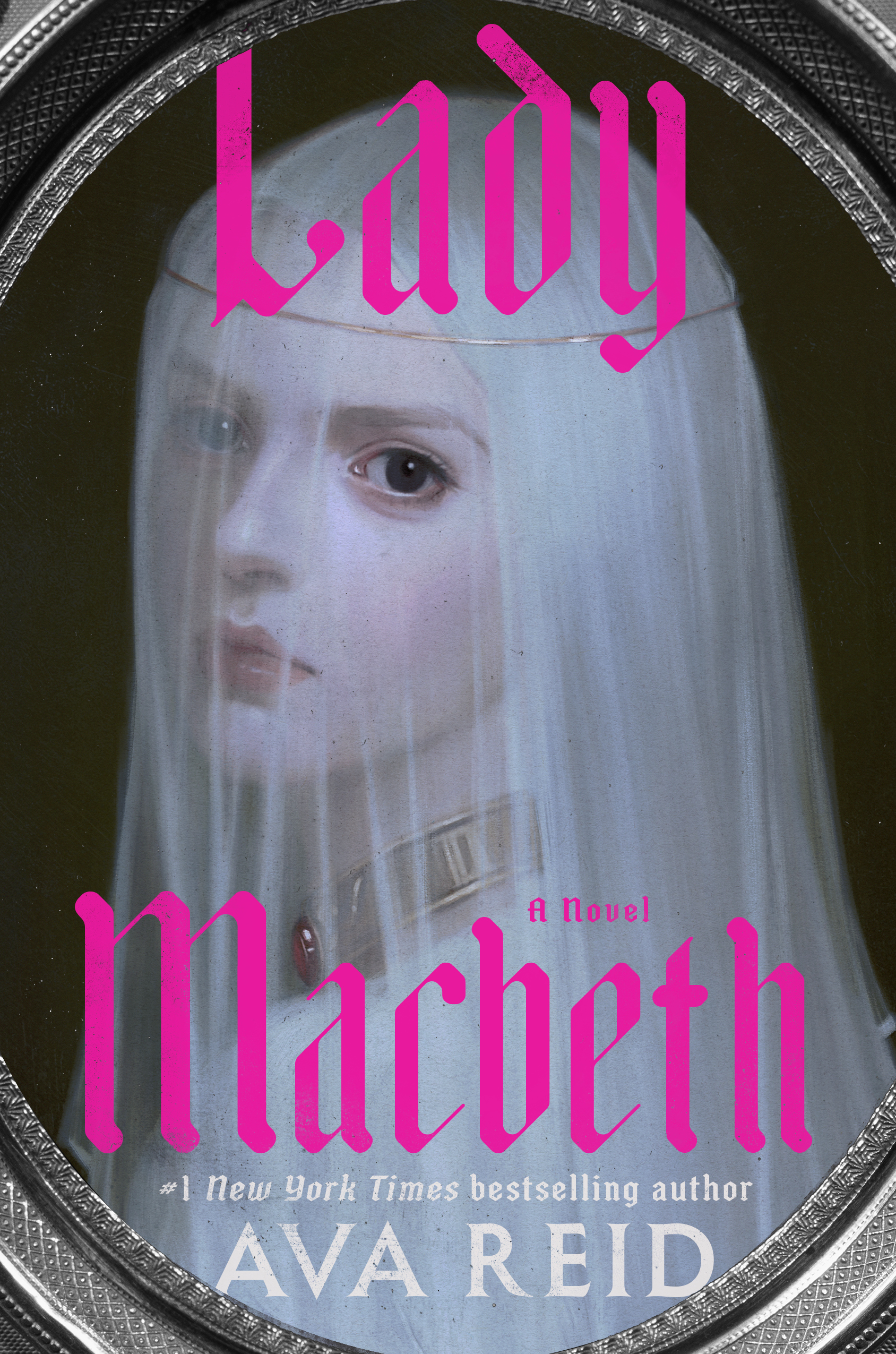
Lady Macbeth
One
"Lady?"
She looked up, out the window of the carriage. Night had fallen with a swift and total blackness. She waited to see how she would be addressed.
For the first days of their journey, through the damp, twisting, dark-green trees of Breizh, she had been Lady Roscille. That name was pinned to her so long as she remained in her homeland, all the way to the choking gray sea. They had crossed safely; her father, Wrybeard, had beaten back the Northmen who once menaced the channel. The waves that brushed the ship's hull had been small and tight, like rolled parchment.
Then, to the shores of Bretaigne—a barbarian little place, this craggy island which looked, on maps, like a rotted piece of meat with bites taken out of it. Their carriage had gained a new driver, who spoke in bizarre Saxon. Her name, then, vaguely Saxon: Lady Rosele?
Bretaigne. First there had been trees, and then the trees had thinned to scruff and bramble. The sky was sickeningly vast, as gray as the sea, angry clouds scrawled across it like smoke from distant fires. Now the horses were having trouble with the incline of the road. She heard, but could not see, rocks coming loose under their hooves. She heard the wind's long, smooth shushing, and that was how she knew it was only grass—grass and stone. There were no trees for the wind to get caught in, no branches or leaves to break the sound apart.
This was how she knew they had reached Glammis.
"Lady Roscilla?" her handmaiden prodded her again, softly.
There it was. The Skos. No, Scots. She would have to speak the language of her husband's people. Her people, now. "Yes?"
Even under Hawise's veil, Roscille recognized her quavering frown. "You haven't said a word in hours."
"I have nothing to say."
But that wasn't entirely true. Roscille's silence was purposeful. The night made it impossible to see anything out the window, but she could still listen, though she mostly heard the absence of sound. No birds singing or insects trilling, no animals scuffling in the underbrush or scampering among the roots, no woodcutters felling oaks, no streams trickling over rock beds, none of last night's rain dripping off leaves.
No sounds of life, and certainly no sounds of Breizh, which was all she had ever known. Hawise and her frown were the only familiar things here.
"The Duke will expect a letter from you when we arrive. When the proceedings are done," Hawise said vaguely. Half a dozen names she had for the Lady, in as many tongues, but she had somehow not found the word for "wedding."
Roscille found it funny that Hawise could not speak the word when, at the moment, she was pretending to be a bride. Roscille had thought it was a silly plan when she first heard it, and it felt even sillier now: to disguise herself as a handmaiden and Hawise as the bride. Roscille was dressed in dull colors and stiff, blocky wool, her hair tucked under a coif. On the other side of the carriage, pearls circled Hawise's wrists and throat. Her sleeves were yawning mouths, drooping to the floor. The train was so white and thick it looked like a snowdrift had blown in. A veil, nearly opaque, covered Hawise's hair, which was the wrong shade of pale.
She and Hawise were of age, but Hawise had a husky Norsewoman's build, all shoulders. These disguises would fool no one; even the sight of their shadows would reveal the ruse. It was an arbitrary exercise of power by her future husband, to see if the Duke would play along with his whimsical demands. She had considered, though, that perhaps his motive was more sinister: that the Thane of Glammis feared treachery in his own lands.
Just as Roscille was a gift to the Thane for his alliance, Hawise was a gift to Roscille's father, the Duke, for not having sent ships when he could have sent ships. For letting the Northmen retreat from the channel in peace, Hastein, the Norse chieftain, had offered the Duke one of his many useless daughters.
Roscille's father was so much more beneficent than Hawise's boorish pirate-people. In Wrybeard's court, even bastard daughters like Roscille got to be ladies, if the Duke thought they could be put to some use.
But as Roscille had newly learned, she was not useful to her father because she could speak her native Brezhoneg, and fluent Angevin, and very good Norse, thanks to Hawise, and now Scots, out of necessity, even though the words scraped the back of her throat. She was not useful because she could remember the face of every noble who passed through Wrybeard's court, and the name of every midwife, every servant, every supplicant, every bastard child, every soldier, and a morsel about them as well—the hard, sharp bits of desire that flashed out from them like quartz in a cave mouth. So when the Duke said, *I have heard whispers of espionage in Naoned, how shall I discover its source?* Roscille could reply, *There is a stable boy whose Angevin is suspiciously unaccented. He sneaks away with one kitchen girl behind the barn every feast day.* And then the Duke could send men to wait behind the barn, and catch the kitchen girl, and flog her naked thighs to red ribbons until the Angevin spy or stable boy confessed.
No. Roscille understood now. She was useful for the same reason that the Duke's effort at disguising her was doomed: She was beautiful. It was not an ordinary beauty—whores and serving girls were sometimes beautiful, but no one was rushing around to name them lady or robe them in bridal lace. It was an unearthly beauty that some in Wrybeard's court called death-touched. Poison-eyed. Witch-kissed. *Are you sure, Lord Varvek, my noble Duke, Wry of beard, that she is not Angevin? They say the House of Anjou are all born from the blood of the serpent-woman Melusina.*
Greymantle, lord of Anjou, had a dozen children and twice as many bastards, and they always seemed to slip into Wrybeard's court with their pale hair, sleek as wet-furred foxes. Her father would not have been shy in admitting to having had an Angevin mistress, though perhaps Greymantle would have chafed at the accusation that his line could have produced such an aberrant creature as Roscille. But the Duke said nothing, and so the whispers began.
The white of her hair was not natural; it was like draining moonlight. Her skin—have you seen it?—it would not hold a color. She was as bloodless as a trout. And her eyes—one look into them would drive mortal men to madness.
One visiting noble heard such rumors and refused to meet her gaze. Roscille's presence at the feast table was so unnerving that it scuttled a trade alliance, and then that same noble (le Tricheur, he was called) carried the story back with him to Chasteaudun and made all of Blois and Chartres shrink from having future dealings with Wrybeard and his court of tricky fairy-maidens. So Roscille was fitted with a gossamer veil, mesh and lace, to protect the world's men from her maddening eyes.
That was when her father realized it was in fact good to have a story of his own, one that could neaten all these unruly and far-flung fears. "Perhaps you were cursed by a witch." He said it in the same tone he used to proclaim the division of war spoils.
This was the Duke's telling of it, which was now the truth, since no one was any the wiser. His poor, innocent mistress bleeding out on her birthing bed, the oddly silent child in her arms, the witch sweeping through the window and out again, all shadows and smoke and the crackle of lightning. Her laughter echoed through every hall of the castle—for weeks afterward it all reeked of ash!
The Duke recounted this to a gathered audience of France's nobles, all who may have heard the rumors and been spooked out of arrangements and exchanges. As he spoke, some of Naoned's courtiers began nodding grimly along. *Yes, yes, I remember it now, too.*
It was only when all the nobles and courtiers were gone and she was alone with her father that Roscille, not quite thirteen, risked a question.
*Why did the witch curse me?*
Wrybeard had his favorite draughts board before him, its latticework of black and white made dull with use. He arranged the tiles as he spoke. *Dames*, the pieces were called. Women.
*A witch needs no invitation,* he said, *only a way of slipping through the lock.*
No one knew exactly what a witch looked like (so in fact everyone knew what a witch looked like), yet they could all agree, it sounded like the sort of curse a witch would give: the shiny apple with the rotted core. *Your daughter will be the most beautiful maiden, Lord Varvek, but one look into her eyes will drive mortal men to madness.* Roscille understood that this explanation offered her better prospects than the alternative. Better to be witch-cursed than witch; better hagseed than hag.
*But—*
"What, are you Roscille of the Thousand Questions?" Wrybeard waved his hand. "Go now, and count yourself lucky it was only le Tricheur who shook like a dog's leg at the sight of you, and not that Parisian imbecile with all his warmongering vassals whom he cannot keep to heel."
The Parisian imbecile went on to start wars with half the other duchies and was then excommunicated twice over. This was how Roscille learned that any man may style himself the Great even if the only achievement of his life is spilling a dramatic ordeal of blood.
Her father taught her to abandon the habit of asking questions, because a question may be answered dishonestly. Even the dullest stable hand could tell a convincing lie if it was the difference between the end of a whip and not. The truth was found in whispers, in sidelong glances, in twitching jaws and clenching fists. What was the need for a lie when no one was listening? And no one in Wrybeard's court suspected that Roscille was capable of listening, of noticing, especially with the veil that hid her eyes.
Roscille of the Veiled Eyes. They called her this in Breizh and beyond. It was a far kinder epithet than she had any right to expect, being a witch-marked girl. Yet she did not wear the thin veil now, not with Hawise. It had been pronounced that women were not afflicted by the madness that her stare induced in men.
Thus the marriage had been arranged on the condition that Roscille arrive by single carriage, with only her handmaiden as company. The carriage driver was a woman who handled the reins clumsily, as she had been taught to drive only for this specific purpose. Even the horses were mares, silver-white.
Roscille realized it had been a long time since Hawise spoke and that the handmaiden was still waiting for a reply. She said, "You may write and tell the Duke whatever will be most pleasing for him to hear."
Once she would have written the letter in her own hand, and paced the room considering how best to relay all the details of the Thane's desires, the treasures that he left unguarded, ripe for Roscille's senses to plunder. *Here is how he speaks when he believes no one is listening. Here is where his gaze cuts when he thinks no one is watching.*
But that letter was to a man who no longer existed. The Wrybeard who sent her away was a man Roscille did not know. Still, she knew the things that would please this other man, as they were the same things that would please any man. The Duke would want to know that his strange cursed bastard daughter was an obedient broodmare and a docile pleasure slave. She understood that these were the two fundamental aspects of wifehood: Open your legs to your lord husband and bear a child that will mingle the blood of Alba with the blood of Breizh. A marriage alliance was only a temporary bond, thinly woven, but if Roscille was good enough it would hold until a son came along and yoked the unicorn to the ermine.
The unicorn was the proud emblem of Skos, all its brutish clans finally and grudgingly united beneath one banner. And it was said that Lord Varvek was as canny as a weasel, so, not one to let an advantageous epithet go unremarked, the Duke put the barb-toothed creature on his coat of arms.
Before, Roscille would have claimed her father's epithet for herself, too, a trait seeped from his blood into hers (was the daughter of an ermine not an ermine, too?). Now she wondered—is the weasel truly clever, or are its teeth merely sharp?
The carriage clattered and strained around a series of narrow turns, up the cliffside, the horses panting hard. The wind was flat and smooth and uninterrupted, as if it was being piped in through a pair of bellows. And then, shocking and sudden, Roscille heard the dragging pulse of the sea.
Naoned, the city of her birth, sat inland on the Loire; until traveling to Bretaigne, she had never seen the ocean. But this was not like that snarling gray channel. The water was black and muscular, and where the moonlight caught the small crests of the waves, it showed a pattern like a serpent's belly. And the water had a steadiness that the wind did not: The surf crashed the rock over and over and over again with the rhythm of a beating heart.
The graces of civilization spiraled outward from the papal seat in Rome, that bright jewel in the center of everything. But the light of the Holy See dimmed with distance: Far from Rome, here was the world's naked, primitive darkness. The castle of Glammis hulked over the cliffside, vulgar and bleak. There was a single long parapet, running parallel to the edge of the cliff, so that the whole wall was a straight, sheer drop to the water below. What Roscille at first thought were crosses were only arrow slits. There were no carvings along the barbican or the battlements, no etchings to protect against pale Ankou, the spirit of Death, who drove his creaking wagon of corpses—every parish and house in Breizh must have such ornaments, or he will come—but perhaps something else kept Death at bay in Glammis.
*Stop,* Roscille thought. The word fell in her mind like a stone. *Please, no farther. Turn around and let me be gone.*
The carriage rattled on.
The barbican ground open to the courtyard. There was a man standing within it, just one. He wore a gray square cloak and a short tunic, tall leather boots, and a kilt. Roscille had never seen a man wear a skirt before. Wool stockings kept his knees from the cold.
At first she thought it was her lord husband come to greet her, but as the carriage drew closer and then halted, she saw immediately that it was not. One thing she knew about the Thane of Glammis was that he was large, as large as a mortal man could reasonably be. This man in the courtyard was by no means small, but he did not have the mountainous stature reported of the Thane: He was ordinary. He had hair the color of a roof's thatching, sun-stripped yellow.
Hawise dismounted the carriage first, then Roscille. The man did not offer his hand to help her, which was terribly impolite by the standards of Wrybeard's court, and Greymantle's, and every duchy or county ruled by the House of Capet. Roscille stumbled a little bit, and she hadn't even donned her bridal gown.
"Lady Roscilla," said the man. "You are warmly received."
The walls of the courtyard might as well have been made of paper, for how well they prohibited the wind. She had never been so cold in her life. Even Hawise, with her hardy Norse blood, shivered beneath the veil.
"Thank you," she said, in Scots. "This is my handmaiden, Hawise."
The man frowned. At least, she thought he did. There were so many furrows on his face—the marks of battle or the marks of age, Roscille could not tell—that she could barely read his expression. His eyes darted to Hawise for a moment, and then back to Roscille, though he did not meet her gaze. He knew the stories.
"I am Lord Banquho, Thane of Lochquhaber and your husband's right hand," he said. "Come. I will show you to your chamber."
He directed the driver to the stables and then directed Roscille and Hawise to the castle. They went up through twisting, half-lit halls. Many of the torches were gone, and there were only black scorch-marks to indicate where they had once been. The abrupt absences of light made their shadows warp and judder against the walls. Now the wind's howling was hushed, yet from the floors there was a strange rasping sound, like the scrape of a ship's hull against the pebbled beach.
"Is that the water?" Roscille asked. "The sea?"
"You will hear it from every corner of the castle," said Lord Banquho, without turning. "After enough time, you will not hear it at all."
She thought she might go mad before her brain learned to omit it. This frightened her more than any ignominy she might—she *would*—suffer to her body, that her mind could be so reduced, turned to pulp like grapes crushed for wine.
Even her father's cold relinquishment of her could not entirely disabuse Roscille of her oldest habits. To soothe herself, she returned to them now. She observed.
Lord Banquho was a warrior; there was no doubt about that. Even when he strode, he kept his arm crooked, so that his thumb might occasionally brush the hilt of his sheathed sword. He would draw his blade in half the length of a heartbeat, she knew.
This was nothing new—Roscille had lived among soldiers, even if the Duke's men had the decency to leave their weapons behind when they were in the company of women. She noticed that the brooch which fastened his cloak was small and round, and made of base metal, not silver. It was something that would rust quickly, especially in this briny air.
Banquho stopped in front of a wooden door. It was gridded with iron. He said, "Your chamber, Lady Roscilla." He was hard on the *c*, making it into one of those braying Scottish consonants.
She nodded, but before she could reply, Banquho removed an iron key from his belt and opened the door. Her empty stomach shriveled. This was a bad sign, that her room had a lock which could only be opened from the outside. She did not even indulge the hope that she would be given a key of her own.
The room itself held a wardrobe, a candlestick with three prongs, and a bed. There was a large pelt draped across the floor, dark and thick, its head still attached. A bear. Its death-empty eyes were two pools that held the torchlight. Its black lip was pulled back in an immortal grimace of pain. Roscille had never seen a bear before, alive or dead; she had only seen their images decorating house seals and war banners. They had already been hunted to extinction in Breizh, but of course they still roamed here. She leaned down and examined the bear's curved yellow teeth, each one the length of her finger.
Banquho lit the tapers, casting the room and all its cold stone in a waxy gleam. "The banquet has been set. The Lord is waiting."
Roscille stood up again. Her knees felt limp, like jellied broth. "Yes. Apologies. I will dress now."
She waited, for the span of a breath, to see if Banquho would leave. The Scots had strange beliefs about women. There were whispers that they still practiced the *jus primae noctis*, the *droit du seigneur*, the right of a lord to share his wife among his men as he did the spoils from his conquests. These whispers had preyed upon her so fiercely that even after she accepted she would be wed, still she did not sleep for days, did not eat for longer, did not even drink until her lips turned white and chapped and Hawise had to force the thinned wine down her throat.
Roscille had heard of a Scottish king, Durstus, who forsook the company of his lawful wife Agasia. This caused her to be forced and abused by his men, in the most villainous and vile manner. Twelve she was when she heard this story, and she knew what it meant.
But Banquho turned without sound and slipped through the door. She was alone with Hawise again, and Roscille nearly collapsed onto the bear-rug.
There was one small relief, like a slant of light through broken stone. The bed was large enough for her and Hawise to share, but no bigger. Not large enough to accommodate the Lord.
They both disrobed in silence. Nakedness, even among women in private, was still uncommon, uncouth. Bodies were meant to be guarded like gold. The flash of a bare ankle was like dropping a pendant, so that everyone could see it clatter to the ground and know that you held its richness and likely more. What else were you hiding in your stores, against your breast? How easily might it be stolen? You could not blame a man for snatching something which had been taunted in front of him like meat before a dog.
As a handmaiden, as a spoil of war, as a girl with no status, Hawise's stores were easy to plunder. Yet her attachment to Roscille had kept her safe, safe from drunken courtiers and their searching hands. She was as virginal as a nun. Soon she would be the only virgin between them.
Hawise had a Norsewoman's build: broad shoulders, small breasts, narrow hips which meant she would struggle to bear children. They were a study in opposites. Roscille's breasts were full enough to need binding under her square-necked gown (why tempt a man with even the suggestion of treasure?). Yet otherwise her body was still girlish, slender, making for an unnatural contrast. Above her waist she had a woman's form, but below she was as lithe as a serpent, something sleek and made for twisting. She wondered what the Lord would think of it.
There was no mirror in the room, only a pail of water, which showed Roscille her bleary, rippling reflection. The veil was as absurd as she imagined it would be. Her limbs were mummified in white linen and lace. Her sleeves were heavy with pearls. Her gown dragged after her like a sodden thing. It was difficult to walk.
"Lady Rosalie," Hawise said—in Angevin, for it was the language these Scots were least likely to know. All of a sudden she reached out and squeezed her hand. "You are the cleverest woman I have ever known, the bravest—"
"You say this as if you are making remarks over my grave," Roscille replied. But she held on to Hawise's hand.
"I only mean…you will survive this, too."
*This, too.* Hawise did not mention the other thing, the first. She didn't have to; they both knew.
Through the thick door, she heard Banquho's voice. "It is time, Lady Roscilla."
The first thing she noticed about the banquet hall was how empty it was. There were six long tables, but none of them were filled to their capacity; in fact, the two farthest from the dais were not occupied at all. Servants skulked about the walls, like brown mice, carrying platters, making no sound. The silence was strange, too. In Naoned, feast days were dense with noise: bards and their songs, courtiers and their gossiping, men bragging of their achievements, women swooning at the attention, draughts tiles rattling, ale mugs clinking. Toasts were made to fruitful harvests and profitable wars. The women wore their brightest gowns and the men combed their beards.
All Roscille heard now was the murmuring of voices, almost as low as the hushing sea. The men at the table pressed their faces close, so that their words passed only in that tight circle. There was the smell of ale, but certainly no mugs were being raised, no toasts made. The men were dressed in the same square cloaks and kilts, weapons at their sides. Warriors, all of them, who would draw their blades as easily as breathing. There were no bards or draughts tiles, and—Roscille realized with a shocked inhale—no women.
This was the strangest thing of all. In the Duke's court, it was essential that there be wives for gossiping and bearing children, serving girls for filling plates, kitchen girls for cooking, and even whores for using, though such things must be done with discretion. It was so dark on their journey that Roscille could not remember the closest town they passed in the carriage; she did not know how far the peasants lived who kept their goats and sheep (this rocky land was no good for farming, not green enough for cattle). Where did the men of Glammis find their pleasure, feed their appetites?
She was so shaken by this she did not notice, at first, that Hawise was being led away from her. "Wait—" she choked out, too loudly—all the men turned to stare. "Please, Hawise is my…"
But Banquho did not turn or falter in his course. Roscille watched as Hawise was taken by the elbow and maneuvered past the tables; she could not keep her eyes on where, because then her lord husband was upon her.
She knew him at once, for his enormity. He blotted out half her vision. Reith, they called him, Scots for "red," which was either for his hair or for his prowess at spilling blood. His hair was tied back with a thong. The Scots, she remembered, wore their hair long. He was younger than she thought he would be, no silver in his beard.
He was handsome, too, though not in the manner of Brezhon men. She had not expected this, yet it did not make anything easier—his features were brusque, rough. His hands were callused and his shoulders huge as rocks. The hair on his arms was tufted and scraggly, like hill grass. He looked like he had been born right from the land of Glammis itself, grown out of the earth; his mother the dirt and his father the rain that watered it.
"My lady wife," he said, in his Scotsman's rasp.
"My lord husband," she replied. Her voice was like wind passing through reeds, almost inaudible.
She was wearing her veil, so it was safe for him to look her in the eyes. Even his stare was heavy, and it weighed upon her. Roscille decided it was wise to shrink from him, for now. He would not tolerate anything less than absolute obedience in the presence of his men. She gathered her arms around her middle. She looked down at the floor.
"Your beauty has not been falsely alleged," he murmured. "Come now. Let us begin."
The next few moments unfolded in near silence. They approached the dais, but before she could step upon it, two of the men advanced toward her. They wore the same tartan as her Lord, so she suspected they were kin. They seized her under her armpits, and Roscille choked on her breath, remembering the story of Durstus and Agasia, that unloved, rudely forced wife—but while these two men lifted her, another man, beardless, his flaxen hair rumpled with youth, knelt before her and tore off her stockings and slippers. Before she could speak, a pail of cold water was thrown over her bare feet.
This was a ritual in Breizh, too, the washing of the bride's feet. But there it was performed by older, widowed women, and gently, with warm water and perfumed soap, while handmaidens fluttered about like birds and gave advice about wifely duties. Roscille gasped as the cold climbed her veins. Not a moment was spared for her shock, her upset. She was set down again, bare-footed, on the dais.
Then the priest came, the Druide, as they were called here. Unlike the religious men in Breizh and France, with their bald heads like little polished rosary beads, the Druide had a long gray beard that touched the floor. It was held in many places with leather thongs, as a maiden's hair was sometimes held with fillets. He did not have a Bible; he knew the words by heart. He spoke first in Latin, while Roscille's teeth were chattering so hard she could barely hear, and made the sign of the cross over her and then Macbeth.
Her teeth stopped chattering long enough that she could listen when he switched to Scots.
"Now is the joining of Lord Macbeth, son of Findlay, Macbeth macFinlay, Macbethad mac Findlaích, the righteous man, Thane of Glammis, and the Lady Roscilla of Breizh," he said seriously, and his words filled the silent hall.
A length of red rope was procured, and she was yoked to her new husband. His left hand and her right. A Scotsman must keep his right hand to himself, in case he needs to draw a weapon. The hilt of the Lord's blade pushed out from beneath his cloak.
"The Lord and Lady Macbeth," said the Druide.
They were both made to turn toward the audience of men. There were scattered grunts of approval, the rapping of palms against the wooden table. Roscille's feet had gone numb. She could not find Hawise in the crowd; where had Banquho taken her?
Macbeth sat, tugging Roscille along like a child's horse-on-a-string. His hand looked enormous beside hers, the knuckles split, his calluses yellow and thick. His nails were bitten to the quick. She could not imagine the Lord chewing on his own fingernails, an anxious habit, betraying an unsettled mind. Nothing else about him suggested such infirmity.
The men raised their cups, and she followed suit, with some clumsiness. She was right-handed and must hold the heavy mug in her left. They mumbled a toast in Old Scots, which Roscille could not understand, but which had the cadence of a song. Then the meal came steaming before them. Cubes of meat in a dark stew. Mutton, not beef (as it would have been in Naoned). She was right about the goats and sheep.
Before she was allowed to eat, the quaich must be passed. The double-handed silver bowl was filled with amber liquid, that strong drink of the Scots, which was said to scorch your throat like fire. Macbeth took one handle, Roscille the other, and together they lifted the quaich to their lips. The corner of her mouth brushed his beard. It was a quick swipe of her cheek, like the sting of running through bramble. She barely tasted the spirit; there was no flavor, only the burning pain it left behind.
The quaich was then passed through the banquet hall: first to the eldest and most proven warriors, then to the youngest, the not-yet-proven. Some of them were even younger than Roscille, boyish still, and they lapped hesitantly from the bowl, like puppies. At last, it arrived in the hands of the flaxen-haired boy, whose cheeks flushed angrily as he lifted the quaich. It was bad fortune to be the one who had the last sip, the one who finally drained it.
Roscille took slow bites with her left hand. As she ate, she observed. The men all wore cloaks and kilts of wool, grays and grayed-out greens, occasionally a slash of red in the tartan. Some of their cloaks had furred collars: a fox here, its bushy tail and black eyes intact, an ermine, showing its winter white. She focused on the brooch pinned to each man's chest. Like Banquho's, they were all made of base metal, iron or something else. No gold or silver, no jeweled inset. In fact, she saw nothing finer in the room than an amber cuff on one of the men, and her own pearls. Even the hilt of Macbeth's sword was no more than tempered bronze.
A hundred years ago, a king, Reutha, sent for craftsmen and artificers from the continent to come to Scotland, to teach the Scots methods of building and smithing and weaving and dyeing. Macbeth was a lord and should not live so sparsely. He was a warrior, too, so where were his spoils?
Slowly, behind her impassive eyes, Roscille's mind began to turn.
A servant entered suddenly from the dark corridor, and Roscille lifted her gaze. She was hopeful that Hawise was being returned. But the man was only carrying a large iron cage, and inside it, a white bird. She had never seen such a bird in Breizh. It did not have the long beak of a waterfowl, nor the faintly iridescent neck of a dove. It was pure white, like the season's earliest snow, each feather arranged snugly against the next, so that it had a sleek, almost wet look.
"Oh!" she said, in heartfelt surprise. Many of the noblewomen in Wrybeard's court kept pretty birds like this, to sing pretty songs. Had her lord husband thought to bring some of Naoned's civility to Glammis? Did he want to please his new wife with a gesture that reminded her of home? "This is a generous gift, my Lord—"
But the servant did not pass her the cage; instead, he flung open the door and the bird fluttered out of it, squealing. The men watched it flail around the ceiling, thrashing about the iron chandelier, bouncing from one stone wall to the next, like a bee drunk on pollen. Roscille was too shocked to speak.
Her husband's hand wrenched from hers. He did not untie the knot; he merely pulled hard enough to tear through the rope entirely, leaving her with a rash of red down her wrist and on her palm, which hurt and made her gasp. Then he had a bow, drawn out from somewhere behind the table, and he was nocking an arrow, and the bird was flapping and then suddenly it was not.
Its movement ceased instantly, gripped by the sudden rictus of death. It fell through the air and landed on the stone floor, hard enough to snap all its fragile bones, but Roscille could not hear the breaking over the sound of the men cheering and stamping their feet. One of them swept up the bird and jerked the arrow from its breast. It had been so immaculately aimed that there was only the smallest spurt of blood, like the pricking of a thorn against the pad of a thumb.
Animal sacrifice was a barbarian practice, sternly abolished by the pope, but Roscille knew it was hard enough for the civilizing Romans to extinguish the tradition of human sacrifice here in Bretaigne; before Christianity the Druides practiced strange rites, casking some of their offerings inside a large wicker statue and setting it alight; others still were submerged by force into peat bogs, which mummified their bodies. Sometimes these bodies surfaced from their hundred-year-old graves, and they looked as shriveled as unborn children, yanked untimely from the womb, skin dyed charcoal black.
As the bird was brought toward the dais, Roscille realized that it was a gift, after all, though not as she initially imagined. This was a show of her husband's strength and skill and virtue, a promise that she would be well protected and well fed and well honored. Not like Agasia.
She reached down and touched the bird's breast, which was still warm. Its feathers were as smooth as she thought they would be. She thought of plucking one to keep as a token, but for some reason the idea made her sad. Macbeth's smile was resplendent. Under her veil, Roscille tried to smile back.
When all the cups had been drained, Roscille walked bare-footed to her chamber. The hem of her dress was still damp; the linen was so thick it would take hours and hours to dry. Her lord husband walked beside her. He wore leather boots and his steps were heavy like falling stones.
They reached the door, and Macbeth removed an iron key from his belt. Roscille wanted to ask how many keys there were, and who had them, and if she would get one (though she knew she would not), and where Hawise was, please, and a thousand other things, but she must save up her words and only spend them wisely, because she did not know how many she would be allowed.
He went into the room first and she followed. The tapers were still lit, though they were mostly burned down now, to stubby white ends that looked like a beast's dull teeth. Macbeth glanced around, almost as if it was the first time he had seen this room, and then his gaze pinned Roscille in place. Her arms were held perfectly straight at her sides, her fingers curled inward.
"Lord Varvek is an honest man," he said. "So far I have been given no reason to think otherwise. You are beautiful, yes, there are none other in the world like you."
Very slowly he was approaching her, until he had her white veil between his finger and thumb, and he was rubbing it like it was an amulet he wished to polish.
"But is the rest true?" he asked. "Do your eyes, disrobed, cause madness in men?"
"The Duke would not lie to such an esteemed and valuable ally."
Roscille thought this was the right thing to say. She knew that Macbeth admired Wrybeard, for having defeated the Northmen and banished them from Breizh. In Alba, the Northmen were the most loathsome villains; the Scots had even made peace with Æthelstan, for God's sake, and no one ever believed there could be any love between Scotland and England, much less a joining of the lion and the unicorn.
No, the Norse were the vilest enemy of all. Roscille worried again what had happened to Hawise.
"It would be unwise to do so," Macbeth agreed. "And your father is reputed to be an exceptionally clever man."
Clever indeed, to use his beautiful bastard daughter to secure a valuable alliance. After years of training her to be an ermine, he had pulled a magician's trick and turned her into a pretty bird instead. Yet for months the question had been wheeling like a gyre, ever since the Duke announced her betrothal: Can the canny mind of a weasel exist within a bird's fragile, feathered body?
Macbeth tucked his hand beneath the veil and ran a finger along her bodice. Roscille's words spilled out then, not at all as she planned them, but rather in a nasty rush of fear: "I know that there is a custom, in your lands. A wedding-night custom."
His brows arched in surprise. He removed his hand. "What custom is that?"
Her breath squeezed through the narrow siphon of her throat. "It is said that the bride has the right to ask three things of her husband, before they share a bed."
This was her slinking little rodent's plan, cloaked in a girl's shaky nervousness. She worried she would have to feign this nervousness, but right now it felt more real than the wisdom underneath.
There were not many books on Alba in the Duke's library, but there was an abbey nearby, and one of the monks was from Scotland, and he knew its history and its rites. The day her father proclaimed she would be wed, Roscille ran to the abbey. She girded herself in the knowledge of this monk, and began polishing the talisman of her own strategy.
It was something she had clung to in dark hours, like a little girl and her straw doll, when the thoughts of her wedding night came. Part of her did not believe she would speak it out loud, that she would try—perhaps still she would be punished for trying, and it would be worse than it ever would have been before. But she must try, or she would lose her mind, too, the mind she had spent so many years trying to whet like a blade. She must keep something of her own, even if it was no more than the belief that, somehow, she may have stopped the ravishment that was to come.
But Macbeth only replied mildly, "And what would you ask of me, my lady wife?"
Roscille was stunned by his placidness. For a moment she froze, waiting for a cruel rejoinder, the knife hidden in his sleeve. Yet no blades flashed. She swallowed.
"A necklace," she said at last. "Gold, with a ruby inset."
This was not part of her initial plan. This she fabricated only hours ago, at dinner, while watching her husband and his men. None of them wore gold or silver or gemstones, and she only had to think back to the whispers she heard in Wrybeard's court to understand why.
There was no precious metal mined in Glammis. It was the remotest, most barren county of Scotland, its only virtues being its enviable position on the water, and the impregnable hills that surrounded it. All of Alba's gold and jewels were mined in Cawder, and because she had listened for so long, she knew: The Thane of Glammis had many enemies, and the Thane of Cawder was one of them.
Macbeth would not suspect that she knew any of this. A necklace was a very common thing for a wife to ask of her husband, especially when that wife was only seventeen, and especially when she had been raised in a court known for its languid opulence. She would seem frivolous and vain and naïve. Not conniving.
Of course, it was well within her husband's rights to simply laugh at her, or even to strike her for her frivolity and vanity and naïveté. But Roscille thought of the white bird and she was sure, in that moment, he would not do any of those things. He cared for her honor, if only out of respect for his alliance with the Duke. She was not some spoil of war, like Hawise.
And Roscille's value was in her face. She would be less beautiful with a bruised cheek, and he would be less illustrious in the eyes of his men, for having so rudely damaged this thing that was valuable only for its beauty. It would be like slashing a horse's knees and then shouting, *Well, will it not run?* He would look barbaric. Worse, foolish.
Macbeth stepped back for a moment, and his gaze went elsewhere. He was not thinking of her anymore. He was imagining the campaign he would wage against Cawder for her gold and her rubies. He was thinking of the glory he would win, all the lands he would be ceded, the riches he would be heaped with, the praises that would be sung in his name. And then, perhaps, in the end he would place the necklace around Roscille's throat, and she would be worth even more to him, because now she was the gleaming symbol that proved his might. He was, after all, a warrior at heart.
"A necklace of gold," he repeated, at last. "Set with a ruby."
She nodded.
He was silent a moment longer. Roscille listened to the sea roaring beneath the floor. Finally, Macbeth met her eyes, through the swaddling veil, and said, "It will add immensely to your beauty, Lady Roscilla."
And then he turned and was gone. It happened so quickly that it stopped Roscille's breath and she collapsed to the floor at last, onto the bear-rug, matted down beneath her bridal veil and lace, tucking her cold feet under herself, and pressing her hand to her mouth so no one would hear her sob.
She was not thinking of the necklace either, not anymore. She was imagining her lord husband's throat opening under the Thane of Cawder's blade, and his blood spilling, ruby-hued, before he could even gutter out a noise of shock.