



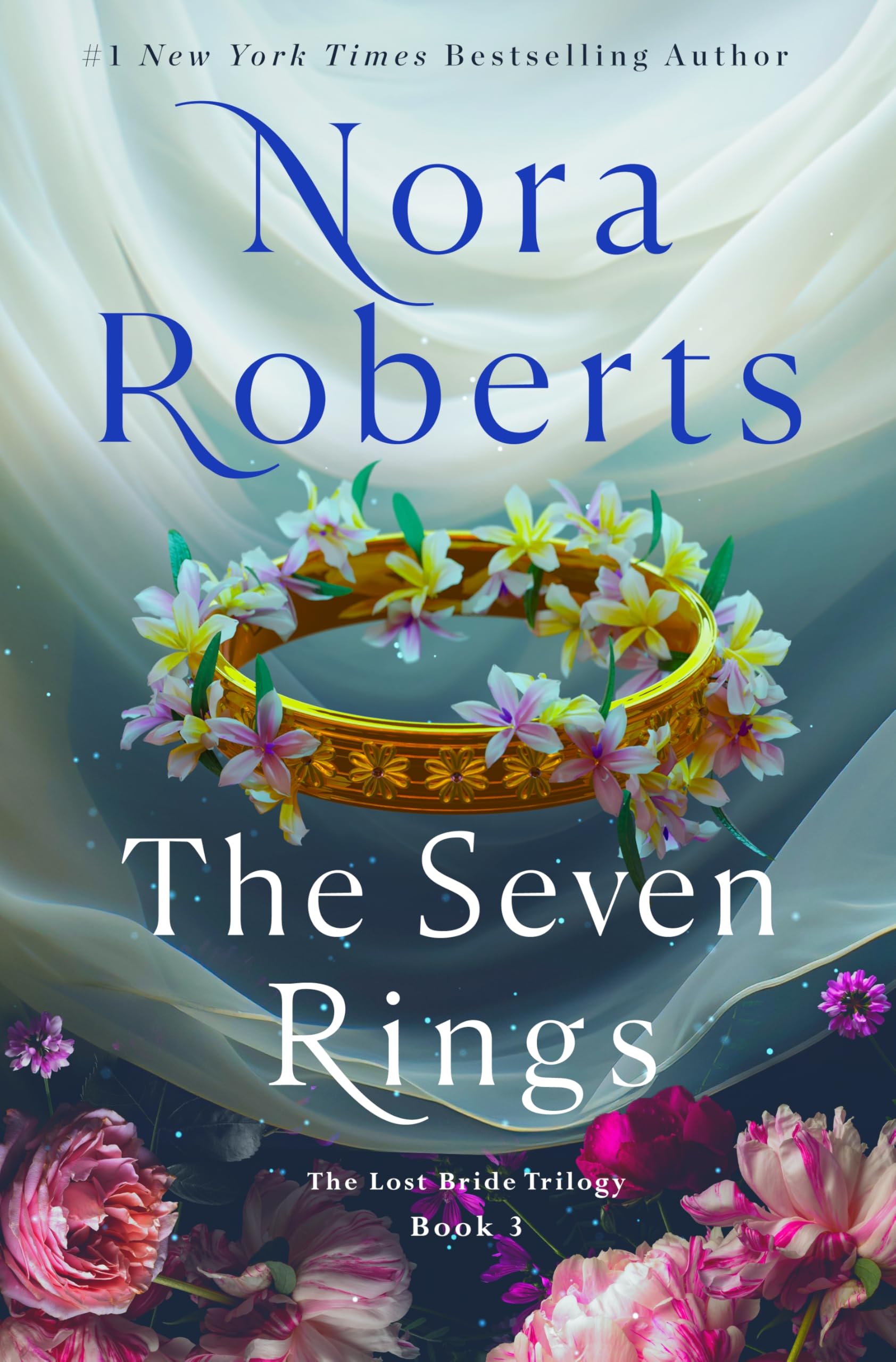
The Seven Rings (The Lost Bride Trilogy #3)
He worked and he learned and he thrived.
This young man of ambition and vision built ships, and built the beginnings of a business. To enrich and expand that business, he, shrewdly, married for money and position.
In time, like flowers in a fallow field, love bloomed there.
With an eye toward the generations to come, he built his business to last. And above that rolling, thrashing sea, he built a grand house, and one to last, with stone and cladded walls, and turrets rising, with massive entrance doors of the finest mahogany.
With his love of the sea, he added a widow’s walk, and often stood there himself, watching his ships sail the fickle Atlantic waters.
His children drew their first breaths inside those walls, and played in the gardens, raced the wide halls, wandered the nearby woods, learned to ride, learned to sail.
Arthur Poole considered himself a successful man, not only a successful businessman, a man who’d risen from poverty to riches who lived on the cliffs above a village that bore his name. But a successful husband and father. A family man.
The family man held great pride in his children, and in the firstborn of his twin sons, who’d courted and won the heart of a lovely (and wealthy) woman.
Collin Poole would marry Astrid Grandville not for advancement, nor money, nor social position, but for love.
On the last day of his life, Arthur Poole rode into his woods in the brisk fall air with his mind, as it often was, on the future.
Wedding plans—the most beautiful and elegant wedding Poole’s Bay had ever seen—entertained him.
He thought of expanding the manor, making more room for the grandchildren to come.
But he would not attend his son’s wedding. He would never see his grandchildren. On that brisk fall day, he fell victim to the dark magic of a mad witch who coveted what he had.
Not the family, not the business, not even his wealth. The manor.
Hester Dobbs would stop at nothing, certainly not murder, to become the mistress of Poole Manor.
And all who knew and loved Arthur Poole grieved what they believed to be a tragic accident, a fall from his horse.
When this death failed to give Hester Dobbs her desire, she murdered Astrid Grandville Poole on her wedding day.
And with that vicious slaying, with Poole blood on her hands, on her tongue, with Astrid’s wedding ring now on her own finger, she laid a curse on the manor, on the future.
A bride in each generation of Pooles would die in the manor, and by her hand.
While she escaped the hangman’s rope, she in her madness returned to the manor. On a night when the clock struck three, and the moon sailed full over the water, she sealed her curse with her own blood.
And leapt from the seawall to the unforgiving water below.
For more than two centuries, the manor stood, stone, wood, glass, watching the great sea. Inside its walls, it witnessed generations of first breaths and last breaths. As Arthur Poole had imagined, the manor grew and held his grandchildren, and their children, and theirs for generations.
And each generation knew tragedy. One bride lost to the twisted lusts of Hester Dobbs.
Until there were seven lost brides, and seven rings on the hands of the witch who killed them.
So within those walls, their spirits remained, as did Dobbs, as did others who either chose to stay or had yet to find their way beyond those walls.
There they walked, and they worked, and they watched.
And they waited for the one who could break the curse.
She came, a woman of Poole blood who’d known nothing of that family connection. She’d known nothing of her father’s brother, his twin, or the heartless scheme to separate them after their mother fell victim to Dobbs’s curse following their birth.
Nor did she know anything of ghosts or curses or the part she had to play.
But she learned.
She came to the manor alone—though she wouldn’t remain alone—to learn of this newly discovered part of her family, to learn their history, to uncover how and why her father had been taken away from his brother.
How was it, though he’d never been to the manor before his own tragic death, that he, an artist, sketched it? How, though he’d never known of his twin, had he drawn a mirror framed with predators where he and a boy who looked like him stood on either side of the glass?
And as she learned, she walked and worked.
When the mirror called to her, she stepped through the glass. She witnessed the death of seven brides, and grieved for them. She witnessed the theft of seven wedding rings, and swore to retrieve them.
With what she’d once believed impossible now her reality, Sonya MacTavish understood the rings were the key to breaking the curse and forever banishing Hester Dobbs from the manor.
For all those who’d come before her, for the house she’d made her home, for those seven lost brides, she vowed to stay and hunt and fight.
Even as death woke all around her.